
Alone Not Alone
a voice wiser than it seemed

Finishing things is a good to time pause and reflect. Here are two recently finished things.
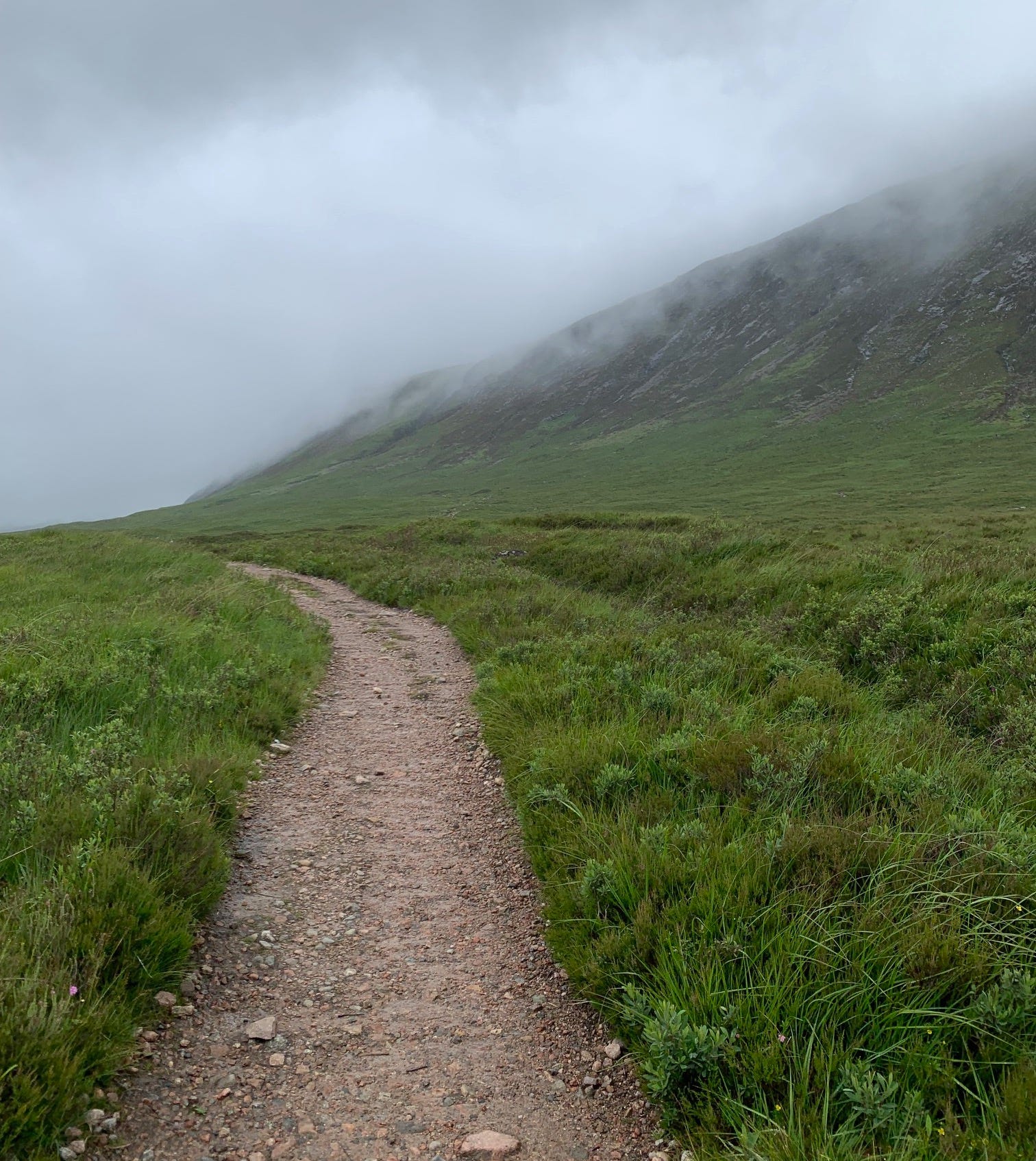
First, a solo hike of 2½ weeks, or 85 leagues, from Edinburgh to Inverness, a trek during which Scotland revealed itself, by explicit demonstration, to be the wettest place on earth, a trek that could hardly have been more beautiful, scrambling along rocky paths that trace the rivers and lochs, cruising the canal tow paths, and roving through highland fields of sheep and cows. (Well, do we call it ‘solo’? Maybe not. See below.)
Second, a wonderful essay by Amanda Peery-Wolf, a writer and poet who recently told of her history of hearing voices in a guest essay on Awais Aftab’s substack. For somebody whose history and experience is similar to hers, it was thrilling to engage with her story. (Similar, not identical. For example, my voices tend to speak straightforwardly and hers often speak cryptically—maybe that’s why she’s a poet and I’m not.)
These two things have overlapped in an interesting way. Indeed, whilst hiking, and prior to reading Peery-Wolf’s essay, I had already been engaging, struggling really, with some of the issues that she raises. She describes how her voices were initially quite negative, and how, over time, she was able to understand their hyperbolic language in terms that make sense in the context of her life. By engaging them, she has been able to appreciate their value.
This same process has occurred for me, but it isn’t easy, and in recent months, I’ve been struggling with a new voice that showed up last summer, and, as described in an earlier post, has turned very nasty. And even though I had once learned and applied more or less the same strategies described by Peery-Wolf, somehow those lessons had become pushed aside, or distorted. Perhaps the main problem was a growing arrogance about my ability to live well even with difficult voices. That arrogance manifested as the false conviction that one could just ignore Mr. Nasty, or tell him to get lost, and poof, he bends to your will. (It wasn’t working.)
Peery-Wolf writes of her own struggle “to build better relationships with my voices,” the importance of which I had somehow forgotten. Her essay thus mirrored and reinforced the lesson that had slowly (re)dawned on me whilst hiking. Attunement, honesty, and subtlety rather than obdurate demand is the path to success. Be a cat, not a mule.
In the meantime, during the hike I had in fact gotten relief from Mr. Nasty, but not through my own devices. To some extent the hiking itself was probably helpful—a sudden need to focus on the daily tasks of living, finding campsites, securing clean water, cooking food, and caring for one’s feet, not to mention keeping the essential things dry.
But it didn’t have to go that way. Indeed, being essentially alone for such a long time could easily have made things worse, especially as Mr. Nasty was still on my mind to a degree; he’s been especially (and vexingly) overbearing of late. It could have been a very rough time.
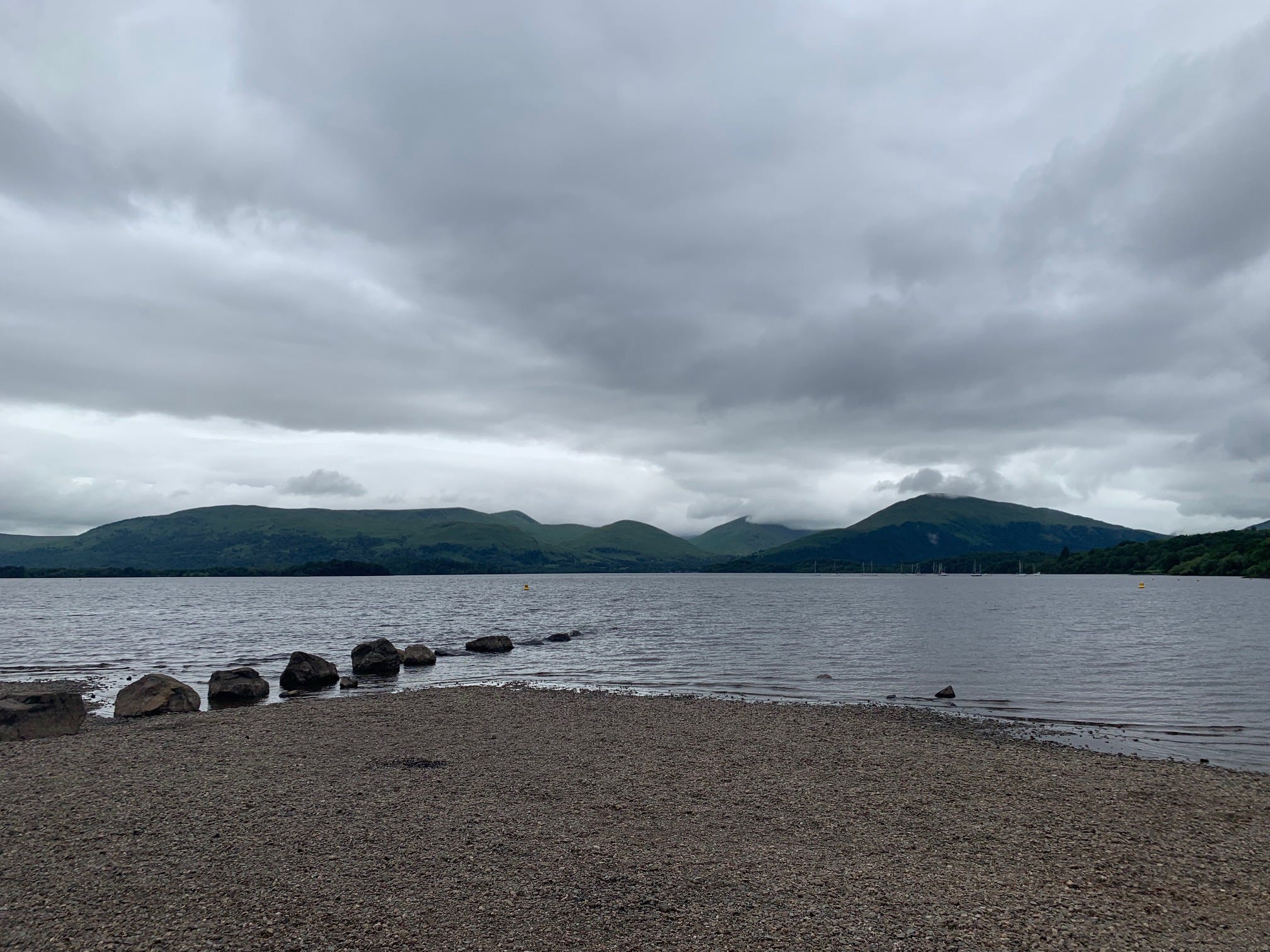
But it wasn’t, and I credit Chris. Chris is another voice. Well, actually, it’s complicated. Chris is also a real person, my best friend, and he’s intelligent and articulate. Chris the person and Chris the voice share a voice but not a personality. Chris the voice comes across as a bit simple-minded and repetitive, but he is always cheerful, and he was a near constant presence on this hike. True to form, even when my feet were screaming and the wind was howling and the path was alternately a mud pit then a mountain stream, Chris would say things like “it’s pretty out here!” on auto-repeat. He was right, of course.
Chris and I have a long standing accord. I try not to be annoyed by his repetitiveness, let him cheer me up, and occasionally respond to him (“Yes Chris, actually it is pretty out here”), and in return when I really need him to be quiet, he is. So we get along just fine most of the time. (Sometimes it feels like a bit much, when his cheery enthusiasm bleeds over to situations where it feels like a nuisance. He’s right and I’m wrong, of course, but sometimes it’s hard to remember to maintain a positive demeanor, and sometimes I take his reminders the wrong way.)
But he’s not usually such a fixture as he was on this hike. Every day he would be with me for hours, sometimes before we even started hiking. (“Nice hot coffee now.” “Yes.”) And yet even while being persistent, he was obliging. When I walked through a town he would go quiet for a bit, which makes talking to shopkeepers, etc., a lot easier. He also tends to speak less when I sing, which is polite of him.
So what’s going on? Why did he become my near-constant companion? It would be natural, of course, to ask him, but I know from experience that Chris does not respond to questions about himself. Even so, I pointlessly tried a few times.
“Why so talkative, Chris?”
“Nice day today.”
“I mean, you’ve been talking for hours every day. What’s up?”
“Nice day today.”
“Yes, nice day.”
So I have to figure that part out myself, and I did some thinking about it as I walked, and it finally dawned on me that I hadn’t run across Mr. Nasty since before the hike began.
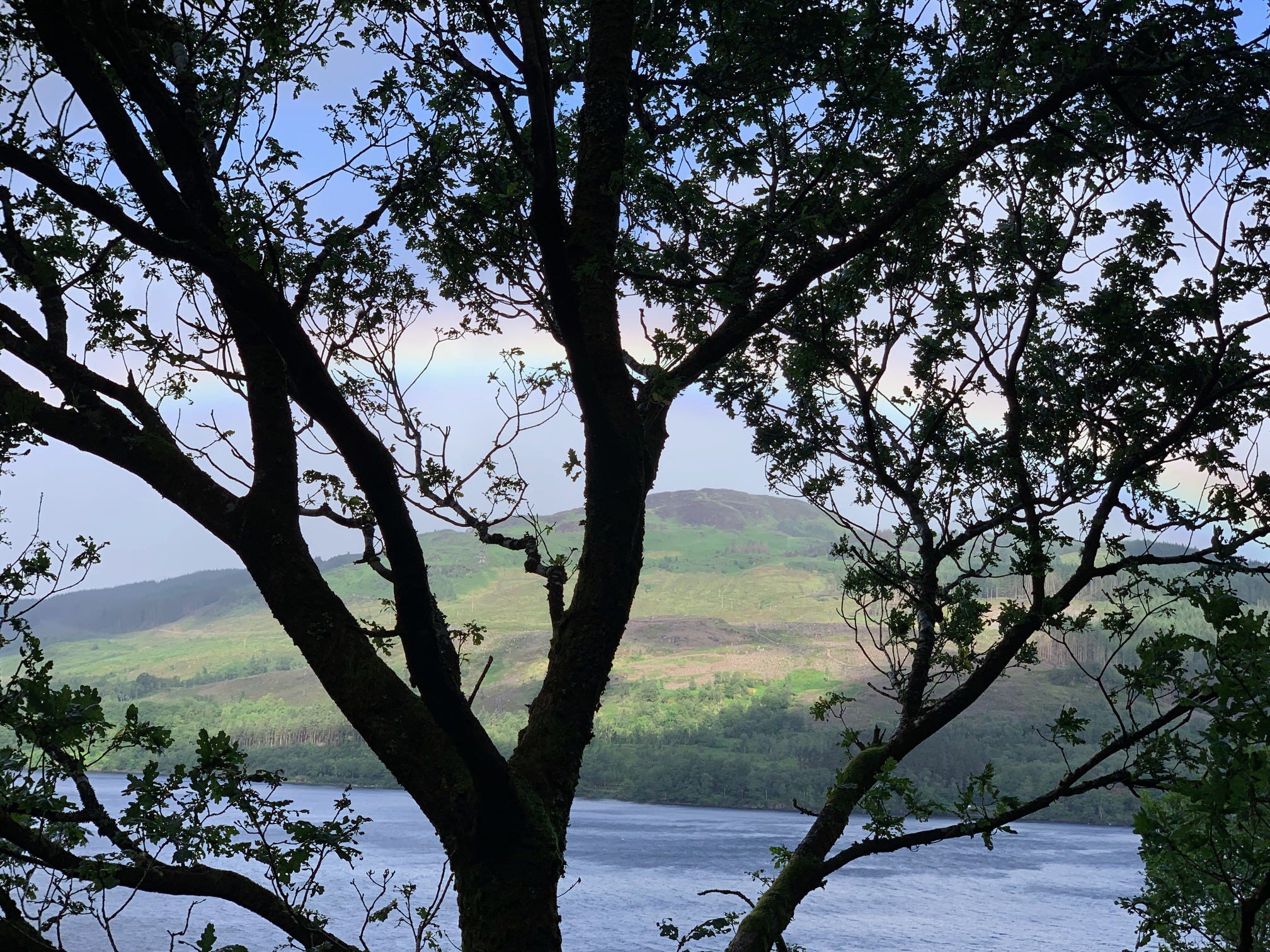
Somewhere along Loch Ness, I came to understand that Chris knew exactly what he was doing. He was correct when he said that the Highlands are beautiful, the clouds are dramatic, sore feet aren’t so bad, and so on. And these observations are valuable. And it was comforting to hear them coming from a familiar voice. But what he was really doing was giving me time away from Mr. Nasty, time to pick up on my earlier mistakes.
So you see, Chris is wise after all, wise enough to do the right thing while giving one the space to figure it out.
I’m thankful for that, and will not squander the opportunity. There’s a new plan. Mr. Nasty hasn’t been around lately, but I suspect he’s lurking around some not-too-distant corner or other. I’m ready. Meow.
You can always count on (any manifestation of) that Chris!