
Ground Zero
a thing maybe learned from description experience sampling

This post is the second concerning ‘descriptive experience sampling’, a process in which one takes (more or less) random samples of otherwise normal experience and then discusses these samples with interviewers, in an attempt to generate some degree of mutual understanding of the experience. See the first post for more background.
‘Discovering Aphantasia’
In the late 1870s, Francis Galton asked his scientist friends and associates to imagine “your breakfast-table as you sat down to it this morning,” intending to follow with questions about the nature of the visual image. In a paper from 1880 in the journal Mind, he reports: “To my astonishment, I found that the great majority of the men of science to whom I first applied, protested that mental imagery was unknown to them.”
Galton’s role in the development of intelligence testing is notorious (a matter for skeptical treatment on another day), but I was unaware of this aspect of his dossier until around 2016, after the term ‘aphantasia’ was coined in a 2015 paper to describe, more or less, the condition that Galton thought he had found in many of his colleagues. Since Galton’s time, degree of visual (and other sensory) imagery has been occasionally studied, and along the way various tests have been proposed, including the oft-cited “Vividness of Visual Imagery Questionnaire” (VVIQ) proposed by David Marks in 1973. (You can read about it, and the later VVIQ-2, on Marks’ own website.)
All of which led to the ‘discovery’ that I ‘have aphantasia’. The inverted commas are meant to suggest that these terms might not be entirely appropriate, and in particular that we might not (i.e., likely do not) have the correct categories for describing the relevant differences in people’s experiences. But that there are differences with respect something like ‘imagination’ seems nigh undeniable.
The earliest modern evidence came from questionnaires such as Galton’s. After prompting an imagination of the breakfast-table, Galton asked questions such as “Is the image dim or fairly clear?” and “Are the colours…quite distinct and natural?” Similar questions appear in the VVIQ, in which various ‘imaginations’ are prompted verbally, and then the subject is asked to rate the ‘vividness’ of the image on a scale from 1 (“perfectly clear and as vivid as normal vision”) to 5 (“no image at all, you only ‘know’ that you are thinking of the object”). The nigh undeniable fact is that people honestly and in good faith give very different answers (and individuals tend to be fairly consistent in their answers across the various questions, and from one session of testing to another).
On the one hand, it is unclear what these differences imply (if anything) about the nature of people’s ‘pristine’ (undisturbed, unprompted) experience, because subjects are told to ‘imagine X’ and so what is being probed, here, is something like “how persons respond to questions about imagination after being pressed to imagine something,” whatever ‘imagine’ might mean for any given person. (For a bit more on ‘pristine experience’ see the earlier post on DES.)
On the other hand, researchers have found some correlation between the ‘results’ of VVIQ testing and other things, such as performance on certain tests of visual recall, and facial recognition. Very tentative evidence of such connections has been explored, for example in a recent preprint on ‘aphantasia’ and prosopognosia (face-blindness).
Much more investigation is needed if any substantive conclusions are going to be justified, and perhaps what is especially needed is investigation of a different kind, not involving prompted experience. One issue with prompts is that they might be especially prone to encourage one to enter into a certain kind of language game in which the word ‘imagination’ is understood to function in a particular manner regardless of whether the act of imagination functions that way for you (‘especially prone’ because the prompt is an imperative, and so the promptee might become especially responsive to ‘what this other person expects from me’). Specifically, at least as I (think I probably) learned to play this game, ‘imagination’ is primarily a kind of private and voluntary manipulation of a scene over which the subject has significant control. In order to be playing the ‘imagination’ game, the word must be used in more or less that manner by all parties, potentially burying the lede:
Studies Suggest: Your ‘Imagination’ and Your Neighbor’s Imagination Might be Very Different
In a popular ‘diagnostic’ technique (but not one used by researchers, who tend to rely on VVIQ), a subject is asked to imagine a scene (apple, beach, sunset, whatever) and then asked to supply details of the scene that were not initially prompted (the color of the apple, the choppiness of the sea). I’m pretty sure that twenty years ago, had I been subjected to this kind of inquiry, I would have confidently answered such questions (“green”, “calm”, whatever), and I’m pretty sure that I would have been more or less making up the answers on the spot. And had I somehow managed to reflect on this fact, I probably would have assumed that everybody else generates their own answers in the same way, that what is happening ‘behind the language’ is the same for everybody. That’s just how ‘imagination’ works, right? I get to say what it’s contents are (because it is private and voluntary and I control it). I’m playing the ‘imagination game’ correctly, same as everybody else.
Around 2016, I began to hear people raise questions like “did you already see it as red, or did you just decide that it is red?” Only then did it begin to dawn on me that (some) other people are actually seeing something when they ‘imagine’. Others have reported a similar reaction (and of course that fact makes it increasingly easy to acknowledge it for oneself). That episode from 2016 affords a lesson: Only after the right questions are asked, only after there is a serious attempt to compare experiences across persons—and ‘serious’ here entails openly confronting the possibility that experiences differ in radical or unexpected ways—are people generally able and willing to begin to appreciate the nature of experience, their own and that of others, just a little bit better.
“Hey! I’m not actually seeing anything at all, and I guess I must have been implicitly assuming that this ‘seeing’ that people are talking about when they ‘imagine an apple’ is some kind of metaphor. It is for me, but it isn’t for them! Gosh people sure are interesting.”
Something like that.
Figure and Ground
All of the above is to say that it feels like the notion of ‘perceptual figure and ground’ is in for similar treatment. One common form of the notion—familiar in the 20th century from Gestalt psychology—highlights the apparent fact that people often organize perceptual experience into objects, and whatever is not an ‘object’ is ‘background’ against which those objects are defined, or at least delineated. So in the classic case of the Rubin vase, either the light part is the ‘object’, a vase, or the dark part is the ‘object’, a profile of two heads.
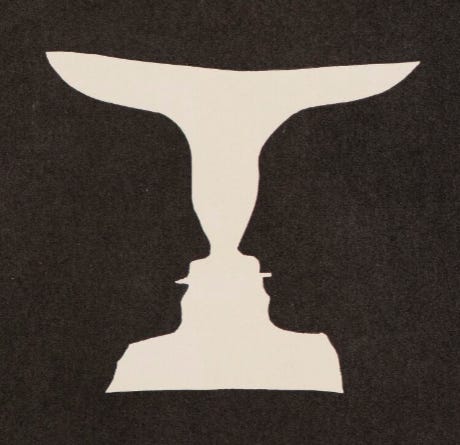
If all we mean by the ‘figure/ground’ structure of experience is that in a visual scene, there are multiple candidates for ‘objecthood’ but only some are selected for conscious attention, then it would be difficult to deny that at least much of the time, experience has this structure. Or at least, it has this structure whenever people are actually individuating objects in their experience. (How frequently is that? Probably nobody knows.)
But a much stronger version of the notion has sometimes been proclaimed by psychologists and philosophers. It is stronger in at least two ways:
The ‘ground’ is presumed to be a part of perceptual experience. A visual experience of the apple isn’t just a seeing of the apple as an object in its own right, distinct from whatever other stuff surrounds it (seen or not). It is also a seeing of that other stuff, visually present and forming the ground for the figure.
This kind of visual experience of the ground is necessary for visual experience to occur at all.
Perhaps the most famous example is Merleau-Ponty (who has much to recommend him in other ways):
When Gestalt theory informs us that a figure on a background is the simplest sense-given available to us, we reply that this is not a contingent characteristic of factual perception… It is the very definition of the phenomenon of perception, that without which a phenomenon cannot be said to be perception at all. (Phenomenology of Perception, Introduction, section 1.)
Various others echo this idea that perceptual experience necessarily has a figure/ground structure, with varying degrees of insistence on the role of the figure/ground distinction for generating the possibility of perception.
It’s the ‘ground’ part that has me confused. Part of my own training in philosophy involved, of course, reading the work of figures like Husserl and Merleau-Ponty, who write as if (something like) the claims (1) and (2) above are just obvious. “Well, if it’s obvious then of course I agree,” and I signed the joint communiqué on figure-and-ground without thinking much about it, and definitely without reading the fine print. How could it be otherwise?
Not so fast.
The DES interviews called this idea into doubt, by raising the following kind of question, initially in an inchoate way, but gradually more clearly and distinctly: “Were you (Michael) actually perceptually experiencing the ground at all?” Of course, when Michael experiences the apple, when it becomes an object of (conscious) attention, he is aware of the fact that there are more things in the world—i.e., more things in his immediate vicinity—than the apple, and in that sense, the apple has been singled out for visual attention, and thereby distinguished from ‘all that other stuff’. But in much the same way that Michael was not visually experiencing the ‘red color of the apple’ in imagination—and indeed, until he is asked, the apple has no color—, it appears that in many cases, at least, Michael does not experience the ground (perceptually or otherwise), even though he could answer questions about it, if asked.
In other words, I think I have come to realize that ‘ground’ is not really (at least not always) part of my experience. It exists only as part of what I believe (sometimes truly!) about the ‘environment’, or as we came to call it late into our interviews, the ‘penumbra’. Much like the redness of the imagined apple, the contents of Michael’s penumbra are implicit and propositional, not perceptual, and not explicitly present in experience. (The difference is that the contents of the penumbra are known or at least believed, while the color of the apple is made up.)
I’m tempted to say that “really it’s probably a matter of degree,” a case of frequently being ‘less consciously aware’ of the penumbra of experience than perhaps many other people are, and that refrain was initially very attractive as I pondered this ‘discovery’. But after further reflection, the refrain feels a bit like remaining beholden to a distinction (‘figure/ground’) that might be generating unhelpful categories.
In any case, whether the concept of ‘degree’ is correct or not, one of the ‘beeps’ (experiences) during DES—let’s call it ‘seeing the guitar’—stands out as especially illustrative both of the lack of a perceptually experienced penumbra and of the power that presuppositions can play in how one reports and even conceives of one’s own experience. During the discussion of seeing the guitar, I was still very much (implicitly and unawares) beholden to the notion that experience must have ‘figure and ground’, while my own experience seems not to conform to that model.
You’ll see that conflict play out in these selected bits of the transcript. (All of the interviews, and transcripts of them, are available on Prof. Hurlburt’s site. As for the ‘ums’ and ‘uhs’ and pauses and restarts, sorry—I guess that’s how I talk…)
10:05 Michael: … And I was trying to relax, and I was trying, and, and I was focusing my attention on, uh, a guitar. There were several guitars in front of me, but I was looking at one of them in particular. And I had almost a kind of tunnel vision. I was very, really, quite focused on the guitar. And th-this wasn’t, this wasn’t the tunnel vision. Like I didn’t see other things. It was more a tunnel vision, like there was just blackness around. So it wasn’t like I was ignoring the stuff in my peripheral vision, or not attending to it, or whatever. It wasn’t there.
…
15:17 RTH: So could I ask one question about that? [Michael: Yeah.] Do you, do you mean blackness that I see blackness? Or do you see nothingness, that all there is, is, the guitar?
Michael: No, I see it [pause] I see [pause] blackness, like, shadow.
15:35 RTH: And is that three-dimensional-tunnel-like? Or just so black that you really can’t tell?
Michael: Probably more the latter.
…
15:50 Michael: I said tunnel, but I, but I, it wasn’t, it wasn’t like, it wasn’t like, look, it wasn’t like looking down a tunnel where that, you can tell that it’s three dimensional. It was only tunnel in the more metaphorical sense of there was nothing else except blackness and guitar.
I was trying to be accurate and open about it! A good clue that I was struggling (and failing) are the pauses after Russ’ question at 15:17. In retrospect, those pauses mean “I’m actually not sure.” A similar thing could be said of the extreme hedging at 15:50. At the time, ‘blackness’ was the best I could do to describe the absence of ‘the penumbra’, the ‘visual stuff surrounding the objects of my attention’ that both Russ and Agnes have reported to me to be a common aspect of their visual experience, and Russ reports having found in many other of his subjects. Something had to fill that space, and so I felt compelled to call it ‘blackness’ when in fact I’m pretty sure, now, that it was just nothing. Not ‘ground zero’ so much as ‘zero ground’.
I’ve since tried to make myself have the ‘figure+ground’ experience, to become visually aware, somehow, of the penumbra. And maybe it has happened. Maybe not. And maybe it happens naturally from time to time. Maybe not. The prevailing feeling is total uncertainty. Most of the time, when an effort is made, either visual attention shifts rapidly from one ‘figure’ to another, or increasing numbers of individual ‘figures’ begin to occupy attention until something has to give. In both cases, there are beliefs about the ‘ground’, the penumbra, and I can sometimes make myself aware of those beliefs in the moment, but it does not seem to be there in visual experience, no matter how hard I try.
What lesson to take? Maybe further reflection or study will reveal something worth saying about this ‘lack of a perceived penumbra’, maybe not. One can (too) easily speculate, of course. I’m now, for example, rethinking the (probably heterogeneous) phenomena that we call ‘de-realization’, which I occasionally experience, especially with respect to my own body parts. Maybe there’s some connection. Maybe not.
But here is one lesson, confidently drawn: We know a lot less about human experience— including our own!—than is comfortable to admit. It is disarming to realize the depth of one’s ignorance even about oneself, and it is an excellent exercise in humility to be confronted with that fact from time to time.