
Hallucination in a Box
What is Learned from Hallucination Simulation?

Last year I was directed to a YouTube video from the news organization CNN, “Anderson Cooper tries a schizophrenia simulator.” (This fellow, Anderson Cooper, is apparently a famous newscaster. I don’t pay attention to such things; perhaps you already know much more about him.) The simulation proceeded in large part by his wearing ear buds, through which various voices are played. While he is interacting with others, the video overdubs the voices that he is hearing through the ear buds, voices that are supposed to reflect the experience of a schizophrenic person hearing voices.
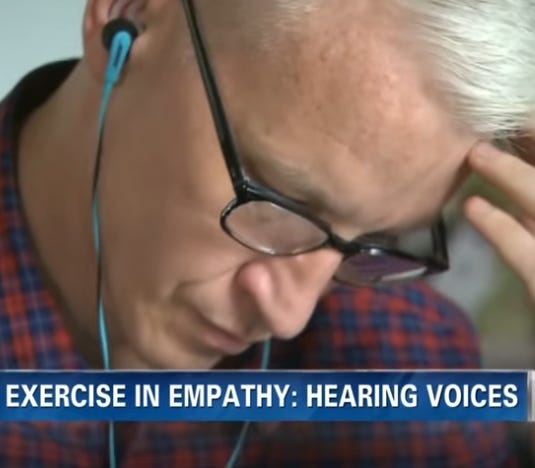
What exactly is being simulated, supposedly? Cooper hears the voices as they emerge through the ear buds, but this hearing is not a simulation at all, of course. He is literally hearing voices, and any adult who is not deaf, or a hermit, has heard voices hundreds of thousands, if not millions, of times. One doesn’t need to ‘learn what it’s like’. Most of you already know.
But of course the creators of these simulations are not attempting to simulate the simple act of voice-hearing per se (the kind of thing that happens when a dinner-partner says “please pass the pepper”). Indeed, the simulation is, as its purveyors say, “specially designed,” although they do not say specifically what is special about it. (If you have $500 handy you can find out for yourself – it is available for purchase. For the sake of the title of this post, let’s imagine that it comes in a box.) So how might such a recording, or the overall experience of listening to it, differ from ordinary ‘hearing people talk’? What, precisely, is being ‘simulated’?
The presumption seems to be that the recording enables one to have an experience that is relevantly like the auditory verbal hallucination experienced by some schizophrenic-diagnosed persons, and indeed the person who originally created the simulation used by Cooper (which isn’t the only one out there) is Patricia Deegan, an activist and psychologist who was diagnosed with schizophrenia, and who (admirably and correctly) promotes the notion that living a decent life with this diagnosis is possible (despite what patients in the 1980s and 1990s, including myself, were generally told about their prognosis—today the messaging is sometimes more positive, at least in some quarters and in some respects). Apparently Deegan heard voices, and one presumes that the recording reflects her own experience, and perhaps the experience of others whose descriptions of their voices were consulted by the creators of these recordings.
There’s that word again—‘reflect’. Somebody like Deegan, who has first-hand experience and can get access to other patients and aspires to be broadly helpful, probably is in a pretty good position to create something that is, in some straightforward sense, a ‘reflection’ of the hallucinatory experience of at least some schizophrenic-diagnosed persons (for example, those similar to her). But reflecting and reproducing are not the same thing. As phenomenologist philosophers have correctly emphasized, experience is always situated, which is not to say that ‘one and the same experience’ may be ‘embedded’ into different situations, but rather that various aspects of one’s situation contribute to making the experience what it is in the first place. Providing the same sensory stimulus to different people does not produce in them the same experience.
If the sensory stimulation is that of a spoken voice, then the ‘situation’ – all of the factors that make up the difference between the abstract notion of ‘hearing talking’ and the actual experience of auditory verbal hallucination – encompasses many things. Here is an incomplete list, with a very brief (and incomplete) description of each. (The most notable incompleteness, perhaps, is that this list sets to one side the embodiment of experience. Saying more about embodiment would involve too much text for now.)
Content
The voices in the YouTube video are mostly negative. There is also quite a lot of variation in what they say over time (although for briefer periods they can be quite repetitive). These features of voices are far from universal amongst schizophrenic-diagnosed persons who hear voices. Some hear exclusively or mostly negative content. Others hear positive, or neutral, content. Some voices are very chatty and say diverse things while others repeat the same phrase or even the same word ad nauseam (or ad insaniam, as it might be). Some are coherent. Some blather. Some address one directly, while others speak in the third person. And so on.
Clearly a simulation cannot capture all of these aspects of content. In the simulation that Cooper uses, some very specific choices were made about content that will match some, but not all, experience (across both persons and occasions). And insofar as content is sometimes very specific to an individual (because it is about that individual’s personal history or situation, for example), reproducing the full range of content is impractical.
Phenomenology
There appears to be great variation in the qualitative features of hallucinated voices, such as their degree of realism (e.g., normal vs. distorted in various ways), tone, intelligibility, location, and so on. These differences clearly have a huge influence on their impact—hearing a barely-intelligible conversation taking place at the edges of one’s experience and hearing a voice directly yelling at you are obviously very different experiences.
As it is for content, a simulation will, by its nature, fail to capture the full range of phenomenological character.
Relationship
It isn’t clear how long Cooper endured the voices—it wasn’t for just the actual length of the video, which shows just a few snips of the process. The simulation he is using is from the Hearing Voices Curriculum (link above), which appears to take place over the course of a day. Let’s assume Cooper did it for a day, or at least several hours. He does say at one point that he felt tempted a few times to stop paying attention to the world and just listen to the voices (and many people who hear voices report or fall victim to this or similar temptations – probably most of us do so at times). The fact that he noticed this reaction in himself indicates that he is indeed getting something from the experience that goes beyond the mere auditory registration of (mostly negative and annoying) voices.
Still, in the course of a few hours or a day, one isn’t going to build any kind of relationship with voices, ‘simulated’ or otherwise. And yet, a huge part of how one experiences voices depends on how one relates to them. (The same is true for actual people, of course – it is easy to be tolerant of, or amused by, the mistakes of a friend, but annoyed by the mistakes of people whom one finds to be generally bothersome.)
Control
Towards the end of the video, and presumably towards the end of his experience, Cooper says “I cannot wait to take these headphones off.” He has no control over the voices at all. They just say whatever they say, when they say it.
For some people who hallucinate, the voices really do have that kind of free reign, but many of us have some, varying (from person to person, from time to time, from voice to voice), degree of control, especially through negotiation. (I’ve never knowingly met a voice-hearer who hasn’t at least tried to control the voices—Cooper obviously has no reason to make that effort.) As reported in an earlier post, I’ve been struggling lately with a new and recently turned nasty voice (which is one reason among others that writing for Substack has slowed, lately), and one of the things that I’ve been working on (among others) is being able to negotiate, with some success. Negotiation can concern the time and place of listening, boundaries on the topics that may be mentioned, and more. (It isn’t 100% successful. I was, for example, more or less incapacitated all day the other day.)
Inasmuch as Cooper is, and knows himself to be, listening to a recording, there is no control, or even the illusion of possibility of control, apart from “taking these headphones off”, which raises another inevitable difference between the schizophrenic experience and the ‘simulated’ experience: For those who hallucinate, regardless of their level of control, there are no headphones for taking off. (A related point that will not be further explored here is that because Cooper is well aware of the origin of the voices that he is hearing, he has none of the uncertainty, anxiety, fear, and frustration that can be involved in hearing voices whose origin is unclear.)
Mood
Hallucination amongst schizophrenic-diagnosed persons is often preceded by or accompanied by a more general ‘psychotic mood’ in which, for example, the world can feel unreal, or in which what is ‘obvious’ to others is entirely uncertain, or in which details that many consider unimportant strike one as extremely important, or in which connections between things that would seem entirely coincidental to many people strike one as significant. I was once sitting in a church and saw a stained glass window depicting St. Barnabas, a window I had seen many times before. But being in a somewhat psychotic mood, the window more or less came to life and everything about it was, in that moment, of the highest importance. Barnabas holds a pale blue book in the window. Books are knowledge. Barnabas knows blue, true blue, a famous dye from Coventry, where there is an absurdly ugly modern cathedral built next to the ruins of the bombed out St. Michael cathedral. St. Michael. That’s me (minus the ‘saint’ part). Barnabas is trying to tell Michael, me, about the relationship between dying and architecture, how the new cathedral is more like a gravestone for the old one. And so on.
That’s how it can go, and this kind of process can become quite entangled with voices and other hallucinations. The ‘simulation’ captures none of it, nor is it clear how it could.
Does it Matter?
In short: ‘hallucination simulators’ are either simulating the bare experience of hearing a voice, in which case they aren’t really simulating at all (because the voice-hearing is just real voice-hearing), or they are simulating ‘what it is like’ for a schizophrenic-diagnosed person to hear hallucinated voices, in which case there are two problems: (1) there appears to be such a wide range of ‘what it is like’ (for example with regard to content or phenomenological character) that simulation is probably more likely to miss the mark than to hit it; and (2) there are aspects of the experience (for example relationships, degree of control, and mood) that cannot be captured by these simulations.
None of the above is intended to imply that the simulation is useless. It does appear that Cooper learned something from the experience, and that he learned something relevant and potentially helpful. For one thing, he wasn’t just listening. He was given a few tasks to perform, including some mathematical puzzles, a simulated psychiatric admission assessment (or anyway a part of it), and basic social interactions in the community (like buying a newspaper). It is not hard to predict that he would find these tasks difficult (and he did), but even though that prediction is easy, there is probably some value in actually experiencing the difficulty rather than just understanding, theoretically or analogically, that even basic cognitive tasks and social transactions are challenging under these circumstances. Indeed, care-givers who have undertaken the training for which this simulation was originally developed do report feeling better able to communicate with and care for patients, and there is no obvious reason to disbelieve them.
However, please do not think that by listening to a recording of nasty voices for a day, one can come to ‘know what it is like’ to hallucinate voices on a regular basis. Here is one testimonial from a psychiatric resident doctor, quoted on the National Empowerment Center website: (which is an organization that appears to be doing great work – the point here is not to disparage them!):
…I recently participated in the ‘Hearing Voices’ training. I must confess, I was disturbed by the sudden realization that I have been treating schizophrenia for four years, yet I have never known what it really was. I may have had the knowledge, but not the wisdom or true empathy – until now.
It feels very doubtful that this person really does, now, ‘know what it is like’.
At the same time, it is far from clear that what doctors or doctors-in-training should be trying to achieve is “true empathy” in the first place (as opposed to rapport and respect). But that’s a nut that we can try to crack a different day.
These are excellent points. I will say, as an educator/psychologist who has used simulations like these in trying to convey to students a very brief experience of "hearing voices," the thing that many students take away from it is the accuracy of the symptoms description being "voices." For whatever reason, for people who have never experienced voice-hearing or may have limited experience with others in their lives who have, there is this weird disbelief that people who hear voices indeed hear voices (auditory stimuli) just like we all hear. It's not just a turn of phrase to describe verbal thoughts. I find utility in that, though of course a simulation would not need to be necessary in order to get that point across...
This is a fascinating statement that I hope gets a future discussion:
"I have been treating schizophrenia for four years, yet I have never known what it really was"
Say I had a thyroid disorder and my doctor had been treating it for years, then they come down with the same disorder. I would find it odd if they said "I have never known what it really was" (until experiencing the symptoms themselves).
And what does the "really" add here?
(Imagine there is another disorder with the same symptoms; once they have those symptoms, do they only now know what those range of disorders really are?)
Your point is that the simulations don't show what auditory hallucination are really like. I wonder if there are some phenomenologically saturated disorders such that--like Mary and the color red--one can't know what it (really?) is unless one knows what it (really?) is like?