
On Walking
a hiking game and its psychiatric (un)importance


The Seedhead Game
For the past 6 days I’ve been walking the John Muir Way in Scotland. Today it joined the West Highland Way, and tomorrow I shall stay on the latter and say farewell to Mr. Muir (a Scot who wound up, for a while, in my childhood home of Madison, Wisconsin--so we’re practically cousins). It seems a good time to reflect on the journey thus far (which will end in Inverness in about 12 days).
I don’t know what other people do to pass the time on long hikes—I almost always hike alone, which is part of the point of it. Singing, thinking, reciting poetry, listening, are my standard activities. I’ve found that if one wears an interesting hat, one can get away with any of these things. I’m pretty sure that hikers or walkers approaching from the other direction hear the singing and think “Hmm, better be careful here” but then they see the hat and their fears dissipate. “This guy’s harmless.” (They are correct.)
Much of this hike, thus far, has been along tow paths and other spots that get decent sunshine (though please remember that we are talking about Scotland, where even the sheep sometimes grow weary of the rain). The result is a variety of grasses growing tall along the path, with their seedheads ripe and erect, begging to be plucked. Hence the game.
Object of the game: Create the seed bouquet with the highest rating.
Procedure: While maintaining a constant, normal, walking pace, grasp a stalk of grass between thumb and forefinger, palm facing down, just below the seedhead. (Species is the player’s choice from among what grasses are available--see ‘Scoring’ below.) Slide the thumb and forefinger up the stalk, stripping the seeds. When successful, the result should look something like this:
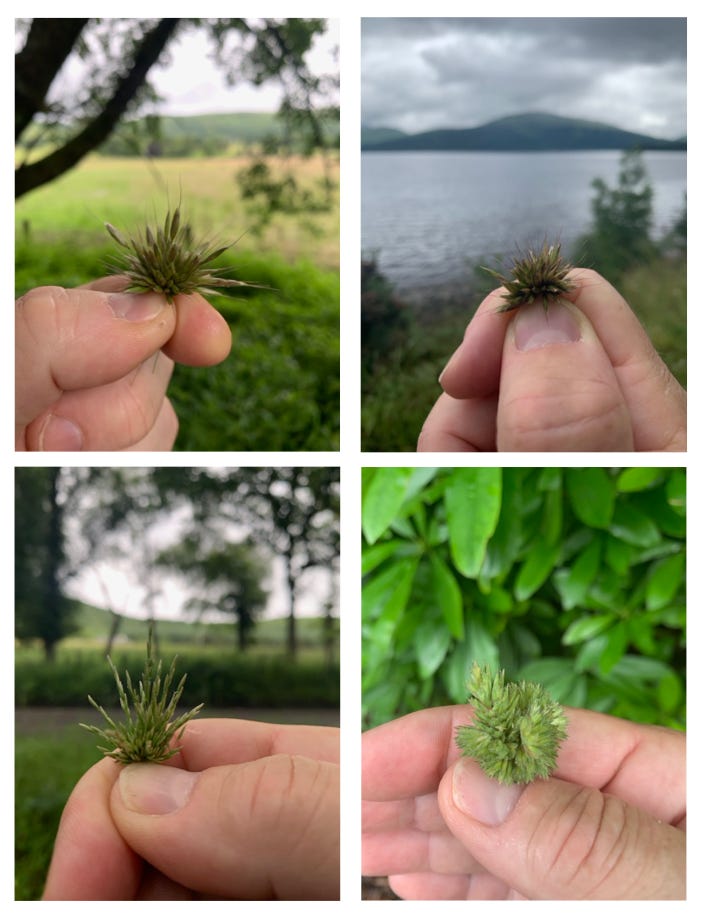
Scoring: A player who has obtained a satisfactory bouquet must locate an animal to score it. Any animal capable of declaring an audible score is acceptable—common choices are large farm animals, pigeons, and domestic pets. Ensure that the animal makes a clear visual registration of the bouquet. Once visual contact is secured, wait 60 seconds for an audible judgment from the animal. (If no judgment is made within 60 seconds, the attempt is nullified and another animal must be located.) Bear in mind that scoring scales differ by species of animal, and that criteria depend on the species of grass. The animal’s declaration is final. If more than one declaration is made during the 60 second interval, the last declaration determines the score.
You might have some questions about this game, but we’ll leave most of the details to your imagination. Here are a few pictures of some judges.

I hope you will consider playing the seedhead game yourself. It’s great fun. People might see you playing and they might think “what is that person doing?” but it’s OK. You’ll still wake up in the morning.
“If you had asked, I would have known...”
I recently wrote about a series of “Descriptive Experience Sampling” interviews (here, and here). The 30-second version (see the first link for more) is that one wears a beeper, records one’s experience at the moment of the (randomly timed) beep, and then reports and discusses that experience with the interviewers.
The interviewers (Russ Hurlburt and Agnes Bolinska) were so very clearly non-judgmental in our discussions that it felt OK (not necessarily comfortable, but OK) to report experiences that I would normally keep to myself. (I was aware, of course, that the entire thing could end up online (with my permission), as it has, but for whatever reason being judged online feels entirely innocuous, while being judged directly, in real time, by people I know, is something I’d prefer to avoid.
Even so, there were several times during the interviews when I felt compelled to say something like (in the midst of reporting hallucinated music, for example) “if you asked me whether other people could hear the music, I would have been able to tell you that they could not.” I was probably trying to manage their impressions of me and to maintain the look of somebody who is still part of the world, as if to say “yes, I hear stuff that other people don’t hear, like cello music, but I’m not a crazy person!” (For the record, I don’t really know what it means to be a crazy person; I just know that things can be inconvenient for folks who are widely known as ‘crazy’.)
Those statements were true. Or at least likely true. I’m pretty good at making correct judgments about which of my own perceptual experiences will be shared by others and which will not. Not perfect. Pretty good.
But the thing to emphasize here is that in the moment of the experience, it is entirely real. There is no difference (much of the time, for me) between hearing ‘hallucinated’ cello playing and hearing actual cello playing, except, of course, that if you were here, you’d (probably) hear the latter but (probably) not the former. But you’re not here, so there’s no difference.
Doxasticism and Psychiatric Assessment
Which brings us to psychiatry. Official psychiatric definitions of delusions cite the concept of a ‘belief’, thereby endorsing what philosophers have dubbed ‘doxasticism’. The typical psychiatric definition of a delusion makes it something like a “bizzarre belief,” typically also with some condition that the belief is resistant to evidence. Philosophers have sometimes disputed this definition (and ‘doxasticism’ in general) on the grounds that delusions are therefore not beliefs in the first place (because bona fide beliefs are ‘by definition’ responsive to evidence, at least to some extent—philosophers love to say that some things are true ‘by definition’, a tactic that my old friend Jeremy Butterfield used to call ‘winning by naming’).
Now I don’t really care how we name these things—I’m skeptical (and some philosophers, such as Eric Schwitzgebel and Zachary Furguson, who have thought about it much more than I have, are too) that ‘belief’ is a univocal term. So I find the philosophical debate about doxasticism not so interesting, at least as it is often framed. It strikes me that ‘resistance to evidence’ is just not a valuable way to assess whether the things that a person says are really all that problematic (and delusion is, at least in the psychiatric context, ‘by definition’ problematic). Rather than worry about what people ‘believe’, let’s worry about what they do, and how they feel.
I’m going to admit something that would likely make some psychiatrists (and maybe even more philosophers) alarmed—not you, dear reader, but some people. Over the past several days I’ve created probably 4 dozen or so seed bouquets, most of them unremarkable or worse. And I’ve presented half a dozen of them for scoring. (None of those pictured here were presented. There are many rules that I haven’t mentioned, and one of them is that photographing a bouquet nullfies all previous and future attempts at scoring. The judges, on the other hand, may be photographed, and four of them are pictured above) And with one exception, they were all scored. And I was confident, in the moment, that I understood the score.
Now, if you had asked me, “did the cow really score the bouquet?” I would have known what to say to you. And indeed, lest you reach for the phone to call for help, I will tell you now that no, cows do not score bouquets. That’s not a thing that happens.
Well, it’s not a thing that happens for us. But in my own experience, that’s exactly what was happening, and as far as I’m concerned, that fact about my own experience sits just fine alongside the fact that ‘for us’ it does not happen. And I really mean ‘us’, not ‘you’.
I’m a very lucky man. I have a good education; my mind is sound; and I can string together words to make sensible arguments and provide reassuring descriptions or characterizations of my state of mind when necessary. I can navigate these tricky waters, in which ‘what seems pretty clear to me’ and ‘what seems pretty clear to you’ are churning into a dangerous blend that could get one of us—probably me—into trouble.
And with that in mind, I say this last part not as an expression of any kind of superiority (it isn’t) but as a fact: Most psychiatric patients who are ‘suspected’ of delusional thinking are not so lucky. They are possibly unable to articulate their experience, neither to themselves and nor to their doctors, in a way that enables them, or encourages a doctor or therapist to help them, to stay afloat in that confusing whirlpool. Perhaps better than ‘being assessed for beliefs that are bizarre and unshakeable’ such people would be better served by being shown how to pilot their own ship—not the ship that others think they should have, but the one that they actually have.