
Words
a triptych

You might reckon that Michael Dickson is the author of these words. His fingers, not yours, are tapping on the keyboard. Even so, we are making these words together, and that’s what makes words interesting.
Panel 1: Word Salad for Breakfast
I awoke this morning, in Scotland, and sat up to find myself in a cocoon of words, three different kinds of words. The first part was expected.
There were visible words, most of them floating in the air, but a few resting near the foot of the bed and the nightstand and the desk nearby, and one balanced, back end up, on the toprail of a chair. The font was libertinus sans, or something like that, many-colored, like a nursery mobile. There were too many to read them all, but if a tender memory can be trusted, they included ‘ash’ and ‘shuttle’ and ‘hollow’ and ‘quench’.
There were audible words, aired by an unfamiliar voice, repeating and echoing. Last summer my wife and I explored the Battery Steele on Peaks Island in Maine. It’s a World War II artillery battery that is three-quarters repossessed by vegetation. Somehow it just lies there, waiting for unsuspecting persons to enter. Its two impressive gun emplacements—now party-rooms for emboldened teenagers, by the looks of things—are connected by an underground concrete tunnel, maybe 300 paces long and 15 across, pitch black inside, flanked by side rooms, complete with dripping water and downright scary stuff, at least in one’s head if not in reality. Every footstep on the soppy, splashy, floor resounded four or six times. The audible words echoed like that: “hill” and “thicket” and “coriander-der-der-der-der.” There were others.
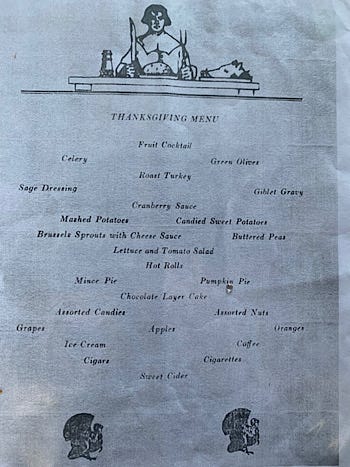
(Somebody with a regard for history left, on a small table in one of the gun emplacements, a copy of the menu for a Thanksgiving meal provided to the troops stationed at Battery Steele. You know it’s genuine because the starter is fruit cocktail, and the afters include cigars, cigarettes, and sweet cider.)
And some of the words were just there. I remember well a great aunt who could not abide us kids. She never spoke to us, and she didn’t need to. Her words were just there: “Get lost little shits.” Those exact words. This morning upon waking and sitting up, the first words were present in just that way—unmistakably there while being neither seen nor heard. Not thoughts, mind you. Unspoken, unseen, words, just there. Some of them allowed themselves to be grasped and others remained anonymous. Unlike my great aunt’s words, these were kind. One of them was ‘glimmer’, but I do not recall any others.
The whole experience was beautiful. The blank, manufactured, dorm room where I’m staying at the University of Edinburgh was temporarily alight with alluring, colorful, echoey, words. Maybe they were left over from the recently departed resident’s last-ditch efforts at preparing for final exams. But unlike that exam-cram (as one imagines it), this whole experience was captivating. It lasted maybe 10 minutes and then for some stupid reason (or, more likely, no reason at all), Michael decided that he needed to stand up, and the whole thing evaporated.
Word.
Panel 2: First Word
My eldest son’s first word was ‘lawnmower’. According to my wife, he would watch lawn mowing from his bouncy chair, with great interest. She noticed his interest and taught him the word, which he picked up almost immediately. ‘Mama’ and ‘Dada’ came later. As a first-time homeowner, his father had slightly more enthusiasm for lawn care than he does now (which is to say, any enthusiasm at all), a modicum of greenswardish concern that was, apparently, magnified manifold in my son’s developing mind, as he watched his father pushing the thing around the yard, its spiral blades spinning in a mildly mesmerizing pattern, slicing through the grass and flinging it aside.
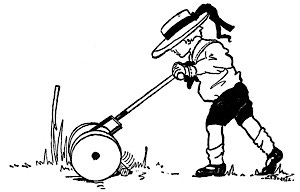
As he learned to walk (and for all I know, before then), he wanted to join in, and towards that end somebody (probably his mother) eventually obtained for him a toy lawnmower. No longer relegated to watching from the kitchen window, he proudly took control of the machine alongside Dad. I remember him standing tall, pushing the thing around, and speaking the word: “mamowah, mamowah, mamowah!” He led the way and I followed.
He wasn’t speaking to anybody. It was not an act of communication, nor indeed an act of naming, calling, chanting, nor serving any of the other manifold practical purposes for which words may be uttered. It was simply an expression of joy, the word gushing repeatedly and tirelessly into the air. If you forced me to say what the speaking was for, I’d say it was an act of creation, or recreation—creation of the lawnmower, of the act of mowing, of the joy itself. In speaking the word, he was making something.
Now it is well known that words, or at least the illocutionary speech-acts that involve them, can make things—promises, commands, apologies, and so on. That’s not what we’re talking about here. We’re talking about making things and emotions and experiences and the like. Words can do that.
Here’s a test to see for yourself. Choose a nondescript square-centimeter or so of something nearby—the desktop, a piece of clothing, the skin on your arm, whatever. What is that square centimeter of wood/clothing/skin/whatever called? The answer, probably, is that it isn’t called anything and the reason is clear: It is not a thing in the first place, but only a part of something else (the desk, the shirt, your arm, whatever). No word, no thing. Maybe that’s what Mary Shelley’s Frankenstein meant when he called language a “godlike science.” (If you are a professional philosopher interested in ontology please look away. We’re not doing ontology here. We’re talking about the real world.)
This creative power of words is (I submit for your consideration) why the first thing one learns when approaching any craft is what the things are called. As a child I was fascinated by an old book in my grandparents’ house called The Boy’s Book of Trades and the Tools Used in Them. The book is largely devoted to naming things, and is full of intriguing words like ‘clinking bat’ and ‘spatera’ and ‘sand hook’ and ‘grunter’. They are things because they have names, not the other way around, and when you speak the names, you experience the joy of creation, or maybe re-creation, or co-creation, or as J.R.R. Tolkien once suggested, “sub-creation”. Let’s’ call it ‘recosubcreation’. (Ho-ho, we made a thing!) As a child I loved to read these words and to say them aloud and to share them with others. The joy in saying them is the joy of recosubcreation.
Word.
Panel 3: Faith

Wittgenstein was wrong that there can be no private language. (Children know it, but many of them either forget or stop caring.) Perhaps he succumbed to the philosophical temptation to declare the limits of one’s imagination to be the limits of possibility.
We are well aware of the danger in saying so: Wittgenstein’s army has perfected the accusatory incredulous scowl. We’re ready for it.
He was pushed, perhaps, by the same thing that trips up many philosophers—an intolerance for uncertainty. Or maybe it is an obsession with certainty. Either way, uncertainty is unavoidable (or if you prefer, certainty is unavailable) if meanings are private. And they are. I cannot look into your mind, and you cannot look into mine. I speak a word and I anticipate, perceive, or hope, that you are attentive, and perchance that we share a meaning, but I do not know how it really goes for you. I’m honestly not even sure what it means for you to ‘share my understanding’. And vice versa. We are at sea together, trying to help each other stay afloat.
But this predicament is not tragic; it is beautiful. Rather than being dismayed by the possibility of drowning each in our own way, let us take joy in our mutual regard and good will, our willingness to try to connect. Communication does not happen with certainty, by appeal to ‘publicly available evidence’—meaning is not use (“a strange mistake to make”). Instead, communication inhabits the trust that we are willing to place in one another. It’s a kind of faith. I speak my words into the air and you receive them. I cannot make an independent audit of your understanding, and pretending that I can is an imaginary invasion of your privacy. I can only press on with the faith that we are both committed to the cause of mutual understanding, a goal whose achievement we can never fully certify.
Nobody can recosubcreate on their own. It takes all of us together. So we can never be certain of success, but we can try. And more important, we can continue to have faith in our mutual efforts.
Word.
Topical:
https://web.archive.org/web/20250911084402/http://philosopherscocoon.typepad.com/blog/2014/03/area-philosopher-constructs-definitive-refutation-of-the-private-language-argument-unable-to-explain.html
Michael, the panel everyone will skate past is the first, and I think it quietly carries the other two. The waking words came to you unauthored. You did not think them; some let themselves be grasped, others stayed anonymous. So before there is any gap between my mind and yours, there is already a gap inside one mind. That makes the privacy you defend stranger than the quarrel with Wittgenstein needs it to be. The faith you describe runs outward, toward a listener you cannot survey. There is an inward version too, the faith with which a single mind receives words that arrive like guests, from elsewhere. Your son's 'mamowah' sits between the two, a word making a whole world with no listener at all. So perhaps it is not only that recosubcreation takes all of us together. A word always comes partly given, past the full reach of whoever holds it, whether the room holds one of us or two.